2026-11-01
The bottleneck is not writing. It is approval.
When AI drafts in seconds, the pile moves to the desk of the person who has to sign. That pile is a new cost, and it can be calculated.
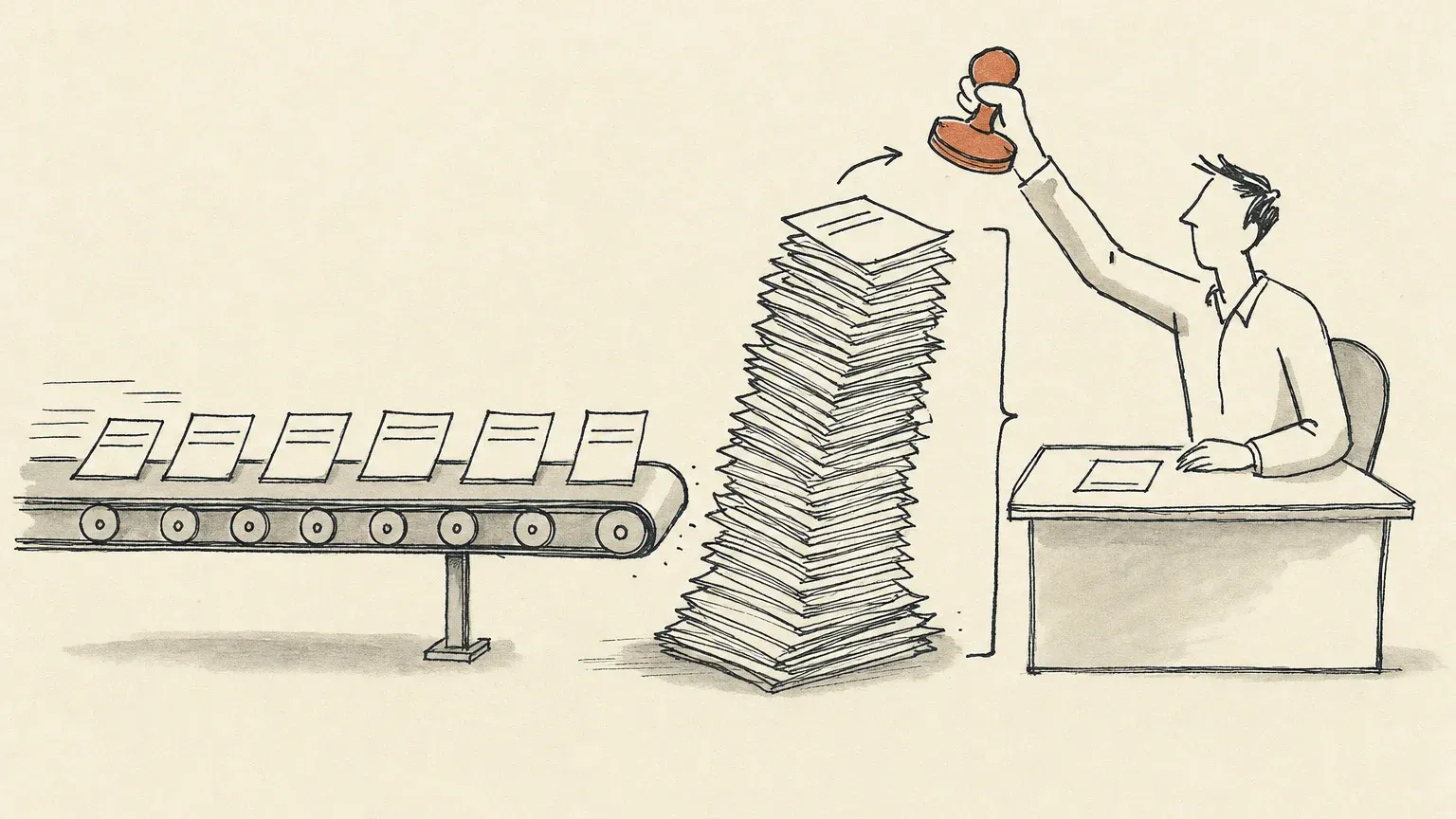
The claim under test: “AI will make the team faster.” The posts carrying it show agent swarms writing a hundred proposals overnight. What they do not show is the desk the next morning.
What we checked
The first source is a field note by @coreyganim on X (25 September 2026): a founder running Claude Code and his own knowledge base has one constraint. Every call summary is reviewed by hand before it enters the base. Generation is instant; ratification piles up. The second is our own content machine: every draft waits for one person to read it, and that step is the slowest by design. So the claim holds halfway. AI removes the cost of producing, not the cost of being responsible.
Why the pile moves
A signature does not multiply. A draft nobody reads either waits or goes out unread; both are worse than no draft. Every saving on the writing side becomes a queue in front of the person who signs.
What to do this week
- Count what waited for your signature this week: invoices, quotes, bookings, posts. One number.
- Colour each queue. Green runs alone and is reversible. Amber runs and reports. Red moves money, is irreversible or leaves the company, and waits for a person. The rule was written on X by @N01ennn; we only apply it.
- One approval screen instead of fourteen email threads. Approve or correct. Every correction becomes a rule for next time.
- Two keys on anything that moves money: one prepares, another verifies against the record, a person presses.
An accounting firm: AI prepares the bookings, the bookkeeper approves them. 2,000 invoices a month × 20 seconds per approval = 11 hours a month that were in nobody’s quote.
Where it breaks
Approval fatigue. By week three, “approve” no longer means “I read it”, and the gate becomes scenery. Two guards: a random sample somebody actually reads, and red items never approved in a batch.
Where DIY stops
The approval screen you can build yourself in a week. What does not come by itself: a trail of who approved what and when; rules that grow out of corrections; red that stays red when someone is in a hurry. Those three are the work we do, if you want it.
The arithmetic
Put in your own numbers; an example, not a promise.
- Manual: 2,000 documents × 2 minutes of entry = 67 hours a month, 800 hours a year.
- With approval: 2,000 × 20 seconds = 11 hours a month, 133 hours a year.
- The EU average hourly labour cost for firms with 10+ employees was €34.9 in 2025 (Eurostat, Hourly labour costs, 31 March 2026).
- Difference: (800 − 133) × €34.9 = about €23,300 a year, but only if an approval really takes 20 seconds. At two minutes per approval there is no saving.
The saving is not in the writing but in how fast and how safely a person approves. Measure that.