2026-07-06
The Knowledge Refinery, explained
How scattered conversations, documents, and decisions become a linked, queryable asset an AI agent can safely work with — in five stages.
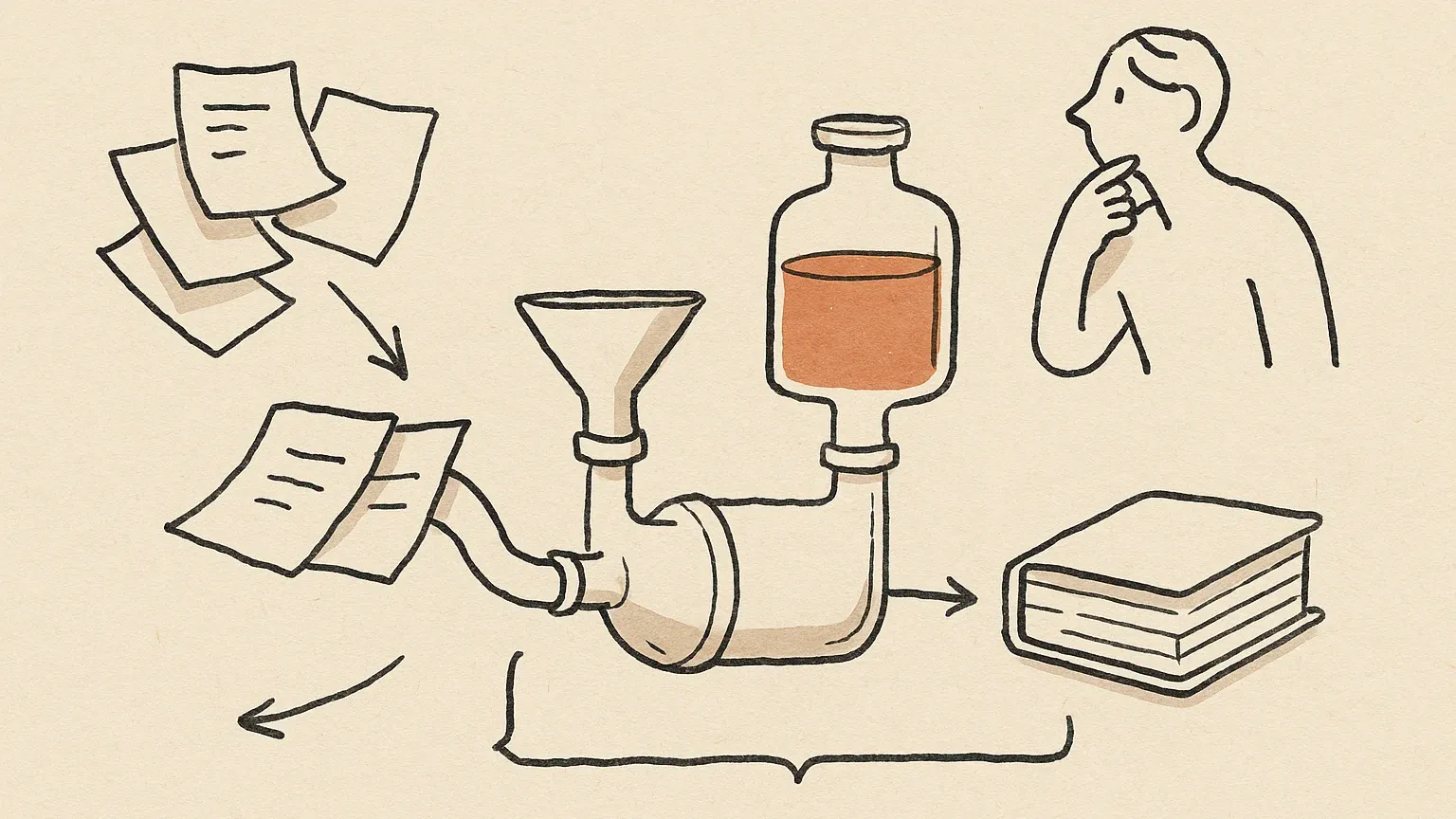
Most tools add another dashboard. We install a refinery — a repeatable process that turns raw, scattered knowledge into a structured asset your team and your agents can both rely on. It runs in five stages.
1. Ingest
Everything a team knows arrives as raw material: conversations, documents, meeting notes, decisions. The first stage captures it into a structured, local-first vault — plain-text files on machines you control. Capture has to be frictionless, or it does not happen. So it is wired into where work already happens: a decision in a thread, a note from a meeting, lands in the vault without anyone “doing knowledge management.”
2. Clean
Raw capture is messy. The clean stage strips personal and regulated data, resolves duplicates, and tags each note with a consistent taxonomy. This is the stage that keeps sensitive material out of reach of any agent, and it is why the later automation can be trusted.
3. Link
A folder of files is not knowledge. The link stage connects related notes, projects, and people, so the vault becomes a graph you can traverse. An employee — or an agent — can follow the thread from a decision to the project it belongs to, to the person who made it, in seconds instead of an afternoon of searching.
4. Query
Now the vault is worth querying. MCP-connected agents read it, answer questions from it, draft from it, and flag contradictions in it. The rule that makes this safe: an agent never writes to the record of truth without human review. It proposes; a person commits. Automation with a checkpoint, not a black box.
5. Maintain
A knowledge base is a garden, not a monument. Left alone, it fills with stale notes, broken links, and outdated decisions. The maintain stage is a quarterly discipline — pruning, repairing, and updating — that keeps the whole thing alive and worth trusting.
Why local-first is the point
Every stage runs on infrastructure you own. The source of truth stays physically inside the company; agents connect to it rather than uploading it somewhere. No external model trains on it. The longer the refinery runs, the denser and more valuable the graph becomes — and the harder it is to give up. That accumulating value is the quiet reason a well-run knowledge system becomes a company’s most durable asset.